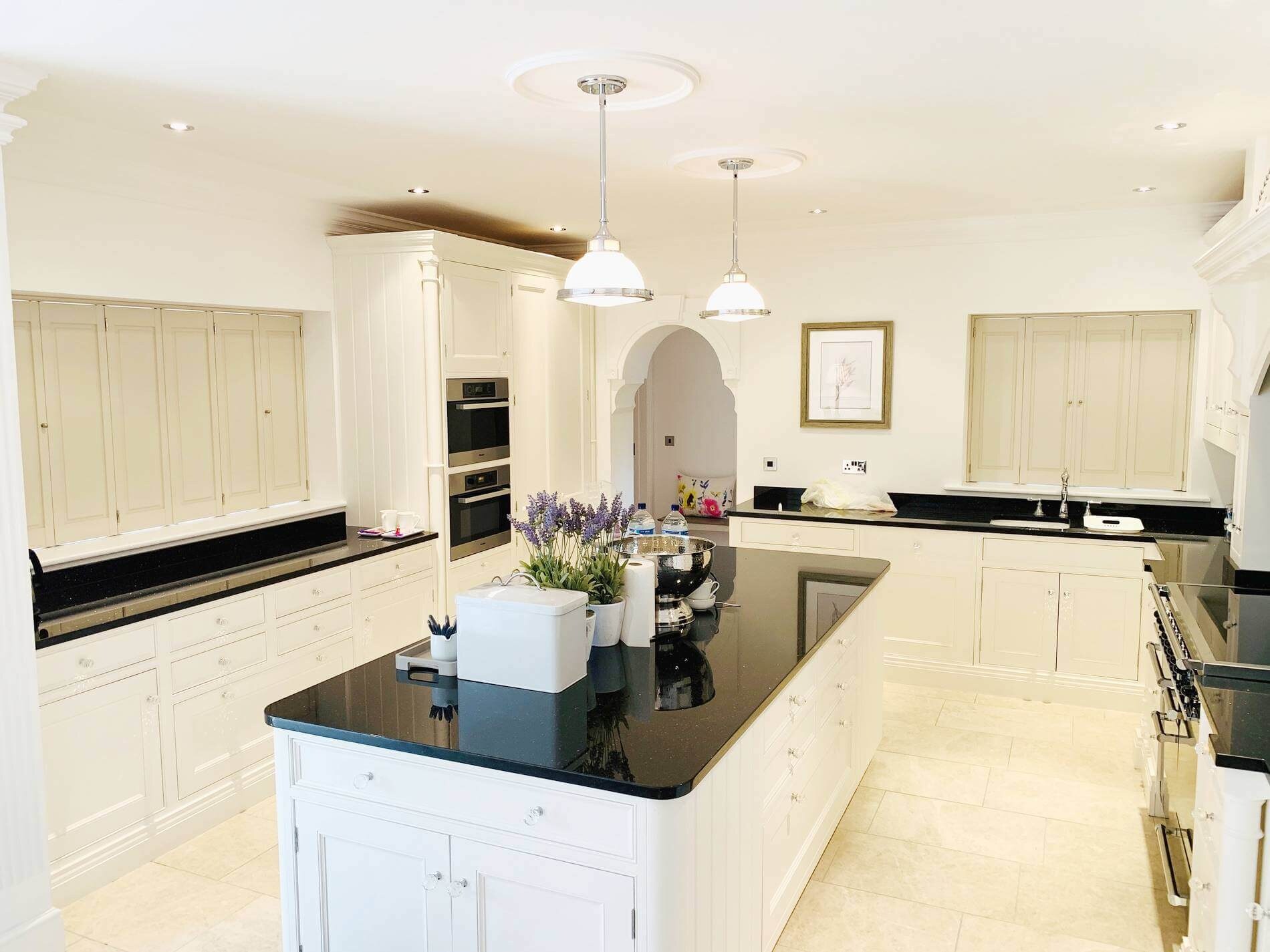
Last reviewed: June 2026 by the Shutter Envy survey team.
MDF plantation shutters are the cheapest option on the UK market by a meaningful margin. They look identical to faux wood from across the room on the day they’re fitted. So the obvious question — the one we hear at almost every survey where the homeowner has done their own research — is: are MDF shutters actually any good, or is the price difference there for a reason?
This is the honest verdict, written from twenty-plus years of fitting both MDF and faux wood plantation shutters across Leicester, Loughborough and the wider Leicestershire area. The short answer is “sometimes” — and the rest of this guide is about which rooms, which budgets, and which buyers it’s actually right for.
The Short Answer
If you want the verdict before the full breakdown:
- MDF shutters are fine in the right room. Dry, low-traffic, low-humidity rooms — adult bedrooms, lounges, hallways, dining rooms.
- MDF shutters are a bad idea in the wrong room. Bathrooms, kitchens, conservatories, utility rooms, anywhere with condensation, anywhere children regularly play.
- The price gap to faux wood is smaller than people think. Roughly 20–30%, which usually works out at £40–£120 per window saved.
- The lifespan gap is bigger than people think. MDF lasts 8–12 years in a good room. Faux wood lasts 15–20+. Over the lifetime of your house, MDF is often not the cheapest option.
- The day-one look is identical. The differences only emerge over time, in moisture, or at the cut edge.
If after reading this you decide MDF is right for you — that’s a perfectly legitimate purchase, and we’ll quote it. If you decide faux wood is the smarter buy, that’s the call most of our customers eventually make. What we won’t do is sell MDF into a room that will destroy it.
What MDF Plantation Shutters Actually Are
MDF — Medium Density Fibreboard — is one of the most widely used materials in modern joinery. Your kitchen cabinet doors, your skirting boards, your interior doors are probably MDF underneath the paint. It’s made by breaking softwood down into fine fibres, mixing those fibres with a resin binder, then pressing the mix under heat into a uniform, dense board.
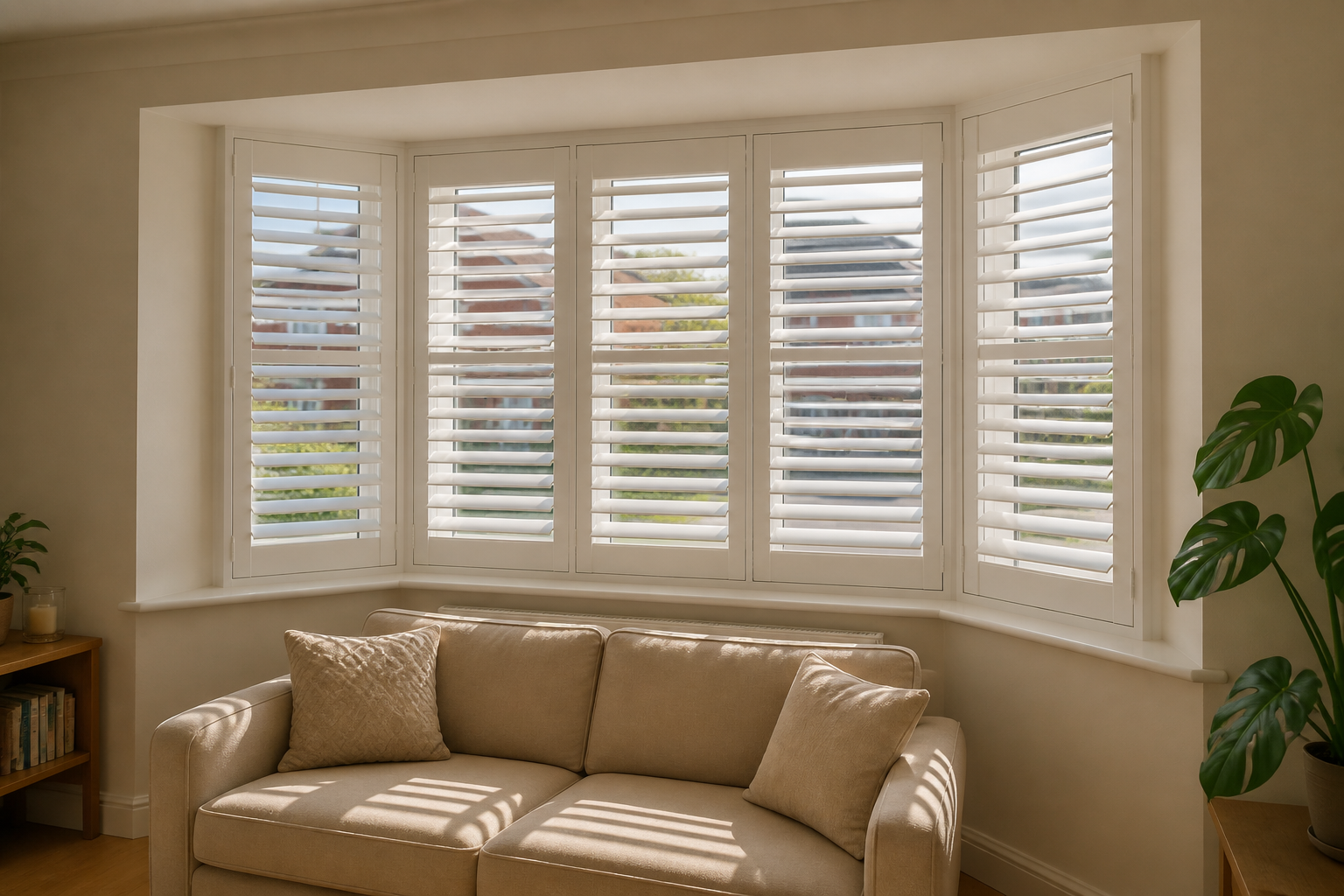
For plantation shutters, MDF is machined into the four components of a shutter — louvres, stiles, rails and tilt rods — primed in a factory, and finished with a sprayed paint coat. The finished item looks identical to a faux wood shutter from any distance: same crisp white, same horizontal louvres, same brass hinges, same tilt-rod operation.
The difference is what’s underneath the paint. Where faux wood has a solid PVC polymer core, MDF has compressed wood fibres held together by resin. That core is the source of every advantage and every limitation MDF has.
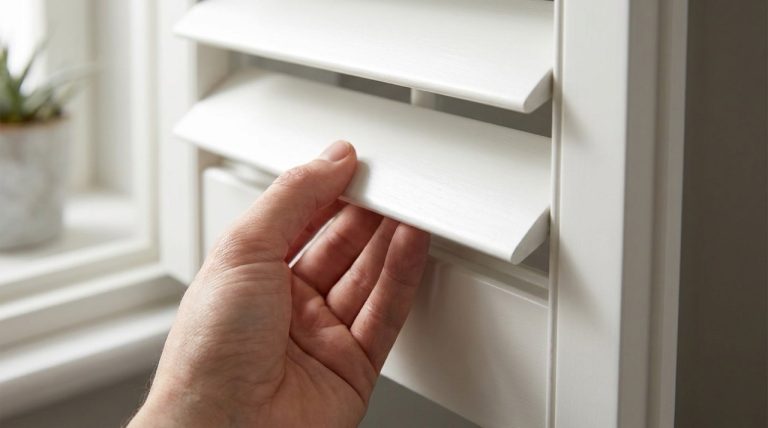
That close-up shows what you’re comparing MDF against: a factory-finished faux wood louvre with a solid polymer core and a hard painted shell. MDF uses the same outward appearance but a fibreboard core underneath — which is why moisture is the dividing line between the two materials.
The Honest Case FOR MDF Shutters
There is a real case for MDF, and it’s worth being clear about it because the rest of this guide is going to be more cautious.
- They genuinely look excellent on day one. A well-made, properly painted MDF plantation shutter is visually indistinguishable from faux wood in a finished room. The mitred frame, the brass tilt rods, the crisp louvres — it’s all there.
- They’re meaningfully cheaper. On a typical UK casement window, MDF runs around 20–30% less than faux wood. For a homeowner on a tight budget who wants the plantation shutter look without the full price tag, that’s a real saving.
- They’re sturdier than you’d think — in the right room. In a dry, low-traffic adult bedroom or a quiet lounge, MDF shutters can serve faithfully for a decade or more without complaint.
- They take colour beautifully. The factory spray finish on MDF holds bold colours (dark greys, deep blues, soft blacks) just as well as faux wood. If you want a colour shutter rather than the standard white, MDF gets you there for less.
If you’re decorating a guest bedroom or a study where the shutter will be opened, closed, and otherwise left alone — MDF will probably make you happy.
The Honest Case AGAINST MDF Shutters
This is where the verdict turns. The case against MDF is dominated by one issue — moisture — and a handful of secondary ones.
Moisture is the killer. MDF absorbs water. Faux wood doesn’t. That single difference rules out a long list of rooms:
- Bathrooms — even with extraction, the humidity from a daily shower will eventually find any chip in the paint coating. We’ve replaced MDF shutters in three-year-old bathroom installations more times than we’d like to count.
- Kitchens — steam, splashes, the condensation that forms on cold mornings. Same problem.
- Conservatories — temperature swings drive condensation, especially at the bottom of the panels.
- Utility rooms — washing machines, tumble dryers, drying laundry. Same problem at lower intensity.
- Any window with persistent condensation — common in older UK housing stock with single glazing or thermal bridges.
Impact damage is a secondary issue. MDF dents under impact in a way faux wood doesn’t. A child swinging on a tilt rod or a hoover knocking the bottom rail leaves a visible mark on MDF. On faux wood, the same impact usually bounces off.
Repairs and repaints are hard. Once MDF is damaged, fixing it is rarely cost-effective. The factory paint finish is sprayed under controlled conditions; a home repaint will look worse than the damage. A professional respray costs nearly as much as a new set of faux wood shutters.
The warranty gap. Look closely at any UK shutter manufacturer’s warranty page. MDF shutters almost always carry a shorter warranty than faux wood. That gap is the manufacturer telling you exactly what they expect to fail first.
MDF vs Faux Wood — The Real Price Gap
This is the comparison that decides most surveys. Here are the typical UK 2026 ranges fully fitted:
- MDF tier-on-tier shutter, standard casement window — £140–£280 per window.
- Faux wood tier-on-tier shutter, same window — £200–£400 per window.
- MDF full-height, same window — £120–£240 per window.
- Faux wood full-height, same window — £170–£350 per window.
The saving is real but modest. On a single window, you’re looking at perhaps £40–£120 difference. On a six-window house, around £250–£700. Over the 15–20 year lifespan of a faux wood install, that saving works out at roughly £15–£45 per year — which is the kind of number where “the cheapest option” starts to look less obviously cheapest. For the full breakdown of plantation shutter prices by material, style and size, see our complete UK price guide.
If your budget genuinely won’t stretch to faux wood, MDF is the right call. If you’re choosing between MDF and faux wood on a “which is best value” basis without a hard budget constraint, faux wood wins almost every time.
The Rooms Where MDF Actually Works
To be specific about where we do quote MDF — these are the rooms where it makes sense:
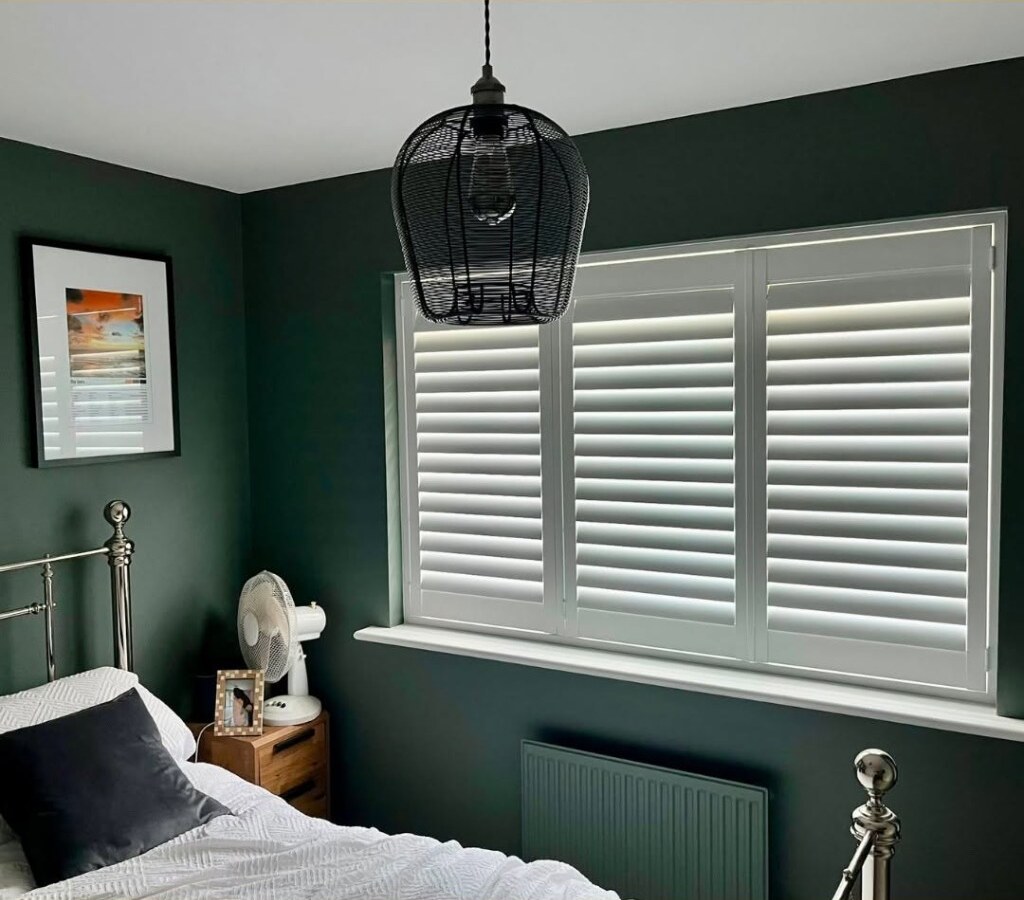
- Adult bedrooms with no en-suite and good ventilation.
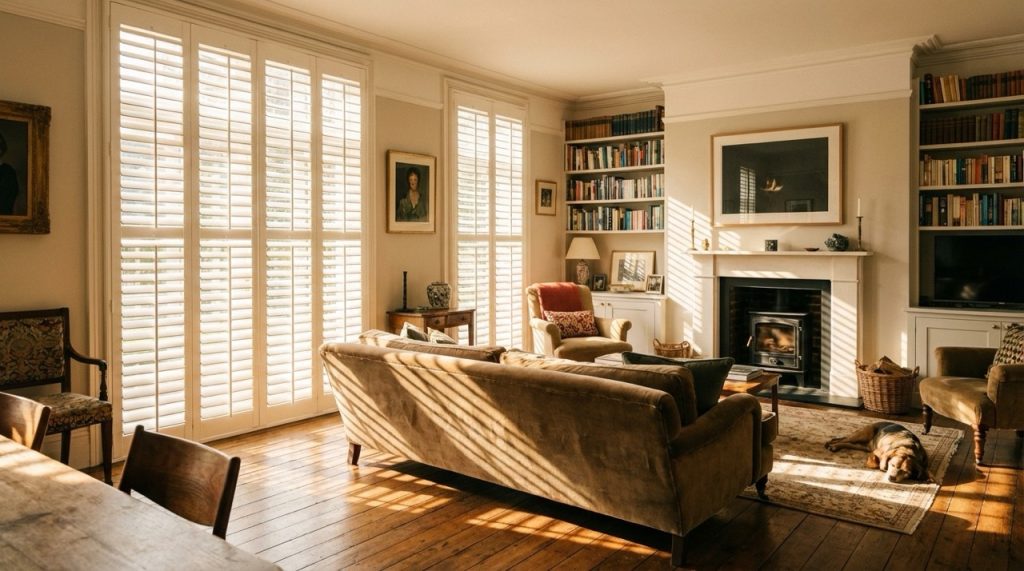
- Lounges and sitting rooms without through-traffic to bathrooms or kitchens.
- Studies and home offices — quiet, dry, low-traffic.
- Hallways and landings in dry properties.
- Dining rooms that aren’t open-plan to a kitchen.

This is the room MDF was made for. Dry, quiet, low-traffic, low-touch. In a room like this, MDF will give you 10–12 years of reliable service for roughly two-thirds the price of faux wood — and that’s a perfectly sensible trade.
The Rooms Where We Won’t Quote MDF
For clarity, these are the rooms we genuinely will not quote MDF for, regardless of budget. The complaint rate is just too high.
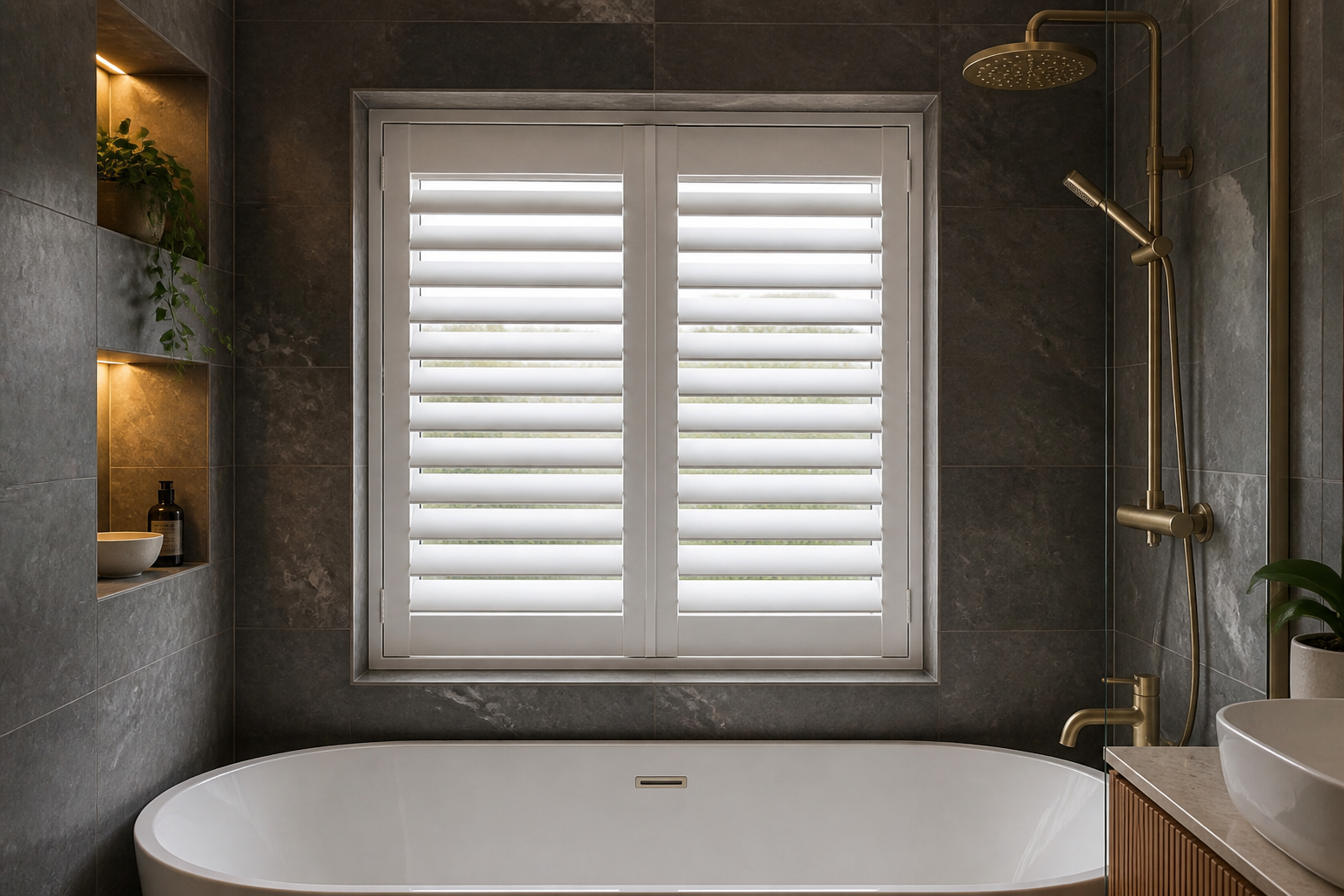
- Bathrooms and en-suites. Always faux wood. Read the bathroom shutter guide for why.
- Kitchens.
- Utility rooms.
- Conservatories and sunrooms.
- Any window with persistent condensation problems.
- Children’s bedrooms and playrooms — not a moisture issue but an impact one.
If a fitter quotes you MDF for any of these rooms, ask them why, in writing.
Lifespan: What We Actually See
This is from real installations we’ve revisited. Take it as field data, not a manufacturer’s claim:
- MDF in the right room (dry, adult, low-traffic) — looks essentially unchanged at 5 years. Minor paint wear on tilt rods at 8–10 years. Hinges may need adjusting around year 10. Most are still in service at year 12; some are starting to show their age.
- MDF in the wrong room (moisture) — signs of trouble within 18 months. Bowing louvres or paint cracking near the bottom rail visible by year 3. Often replaced by year 5.
- Faux wood, any room — usually unchanged in appearance at 10 years. Slight tilt-rod wear at 15 years. Most are still going strong at 20+.
What to Ask the Surveyor
If you’ve read this far and still aren’t sure whether MDF is right for your project, four questions to put to whoever surveys your windows:
- Which rooms are you proposing MDF for and why? They should give you a room-by-room reason, not a blanket recommendation.
- What’s the warranty on the MDF compared to the faux wood option? This is usually written down somewhere; ask to see it.
- What’s the price gap on this specific job? Get both quotes side by side so you can see the real-money difference, not a percentage.
- Will you put in writing that this room is suitable for MDF? A surveyor who has surveyed your room properly will. One who hasn’t will dodge.
If you’re considering material choices more broadly, our deeper wooden vs faux wood comparison covers the next level up — when it’s worth paying for real hardwood instead of faux wood.
Book a Free, Honest Survey
We’re a local Leicestershire shutter specialist and we’d rather lose a quote than sell you the wrong shutter for your room. Mark visits, measures every window personally, brings physical samples of both MDF and faux wood so you can feel the weight and edge difference yourself, and gives you a quote with both options priced out where MDF is genuinely appropriate.
Book your free home survey → or call 07729 572277.
Frequently AskedQuestions.
What are MDF shutters made of?
Are MDF shutters waterproof?
How long do MDF shutters last?
Are MDF shutters cheaper than faux wood?
Can I paint or repaint MDF shutters?
Are MDF shutters good for bedrooms?
Should I buy MDF shutters?
Need advice for your own bedroom windows?Arrange a home visit →