Last reviewed: June 2026 by the Shutter Envy survey team.
Aluminium plantation shutters look like ordinary plantation shutters at first glance. They cost about twice as much. So why do we recommend them more often than you’d think? The answer is that they were built for jobs ordinary plantation shutters were never meant to do — and in the right room they are the only sensible choice. This is the honest UK 2026 buyer’s guide.
For the commercial category hub — rooms, costs and when aluminium earns its premium — start with aluminium plantation shutters. For the specific range we fit, our Portchester aluminium shutters page covers product specification, colours and lock options. This guide is the deeper buyer’s read.
The Short Answer
Before the full breakdown, here’s the verdict:
- Aluminium plantation shutters are not a different colour of plantation shutter. They’re a different product entirely — built for security, weather and durability where wood and faux wood will eventually fail.
- They cost about twice as much as faux wood. Roughly £600–£1,400 per window fitted in 2026.
- From across the room, they look like premium plantation shutters. Up close the louvres are slimmer, the edges crisper, and security uses individual key locks — not a centre tilt rod or pull handle.
- Right rooms: conservatories, south-facing rooms, bathrooms with persistent condensation, ground-floor patio doors and French doors where security matters.
- Wrong rooms: dry first-floor bedrooms, north-facing living rooms, anywhere faux wood would already do a perfectly good job. Most houses end up with aluminium on two or three openings and faux wood everywhere else.
What Aluminium Plantation Shutters Actually Are
Aluminium plantation shutters are made from construction-grade extruded aluminium — a heavier, harder specification than the lightweight sheet used in cheap window dressings, and the same grade used in security and architectural applications. Each louvre, stile, rail and frame section is a hollow aluminium extrusion pressed from a single billet, then powder-coated in your chosen colour. The internal chambers in the louvres are what give them their strength while keeping the weight close to a faux wood equivalent.
This is structurally different from every other shutter material:
- Wood and faux wood — solid material with a painted surface; the surface is the moisture barrier.
- MDF — pressed fibre with a painted surface; the surface is the only moisture barrier and any chip kills it.
- Aluminium — the material itself is the moisture barrier. There is no painted surface to fail because the powder-coat is baked into the metal and the metal underneath doesn’t absorb moisture at any temperature or humidity.
That single difference is the whole pitch. Aluminium doesn’t warp, it doesn’t bow, it doesn’t crack, it doesn’t fade, it doesn’t rot, and it doesn’t get pushed through with a screwdriver. Wood and faux wood do some combination of all of those over enough time in difficult rooms.

This is the Portchester aluminium range we fit — satin white in a kitchen setting. The louvres are noticeably slimmer than faux wood, the edges are crisper, and security is handled with individual key locks rather than centre tilt rods or pull handles. Up close you can see why aluminium reads as a more refined, architectural shutter even though it looks like standard plantation from across the room.
The Honest Case FOR Aluminium
There is a real case for aluminium, and it’s a case the rest of the market often soft-pedals because the price tag scares people off. We want to be clear about where it genuinely earns its premium.
- Security on ground-floor openings. A standard plantation shutter is a privacy product. An aluminium plantation shutter with a proper key-locking system is a security product that happens to look like a plantation shutter. For patio doors, French doors, accessible side-return windows and rear extensions, that’s a meaningful upgrade — and one your home insurer often recognises with a small premium reduction (worth asking before installation).
- Conservatories and orangeries. UK conservatories swing between 5°C in winter and 40°C+ in summer, with heavy condensation. Wood warps, faux wood softens on south-facing roof glazing, MDF fails outright. Aluminium does nothing. If you’ve been told your conservatory is unsuitable for shutters, this is the answer.
- South-facing rooms with intense sun. Direct UK summer sun is harder on wooden shutters than people realise. We’ve seen faux wood shutters cup and bow slightly on south-facing bay windows in their fifth or sixth summer. Aluminium is unaffected.
- Bathrooms with persistent condensation. Faux wood is the standard correct answer here, and on most bathroom windows it’s fine. For bathrooms where condensation regularly visibly streams down the window (poor extraction, single-glazed window, north-facing cold wall), aluminium is the genuinely permanent option.
- Coastal and salty-air homes. Rare in Leicestershire, but mentioning it for completeness — salt-laden air degrades faux wood and metal hardware over a decade. Aluminium with the right marine-grade powder-coat is the long-term answer.
- Long-term low-maintenance ownership. Aluminium shutters routinely look unchanged at fifteen and twenty years. Faux wood usually does too, but in difficult rooms it doesn’t. If you intend to stay in your home for the next twenty years and you want the cost spread across that horizon, aluminium often works out cheaper than replacing wood twice.
The Honest Case AGAINST Aluminium
The case against is straightforward: in rooms where the case FOR doesn’t apply, you’re paying double for benefits you won’t use.
- Most first-floor bedrooms don’t need it. They’re dry, they get less direct sun, and there’s no security argument because nobody can reach the window without a ladder. Faux wood is a more sensible buy.
- North-facing living rooms don’t need it. No intense sun, no moisture, no specific security concern. Faux wood again.
- Hallways, landings, studies, dining rooms in normal modern homes. Faux wood handles all of these for half the price.
- Tight budgets. If aluminium would stretch the budget so thin you’d compromise on installation or finish elsewhere in the house, fewer windows in faux wood is better than every window in cheap aluminium.
For most UK homes we survey, aluminium ends up being the right answer on two or three specific openings and faux wood on the rest. That’s the pattern.
Aluminium vs Roller Shutters (They’re Not the Same)
This is the single most common confusion at the survey door, so it deserves its own section.
- Roller shutters are the chunky slatted external units that roll up and down inside a housing box above the window. They’re typically used on shops, rear extensions and security-conscious commercial properties for full external lock-down. They are not plantation shutters by any reasonable definition.
- Aluminium plantation shutters are interior shutters that look almost exactly like wooden or faux wood plantation shutters — same hinged panels, same horizontal louvres tilted from the inside, same plantation aesthetic — just made from aluminium for the structural and security reasons above. They live inside the room. They don’t roll up. From the street, they look like beautiful plantation shutters because that’s what they are.
If you want the plantation look on the inside of your house, you want aluminium plantation shutters. If you want hardened external coverage that disappears into a housing when not in use, you want roller shutters. They’re different products solving different problems.
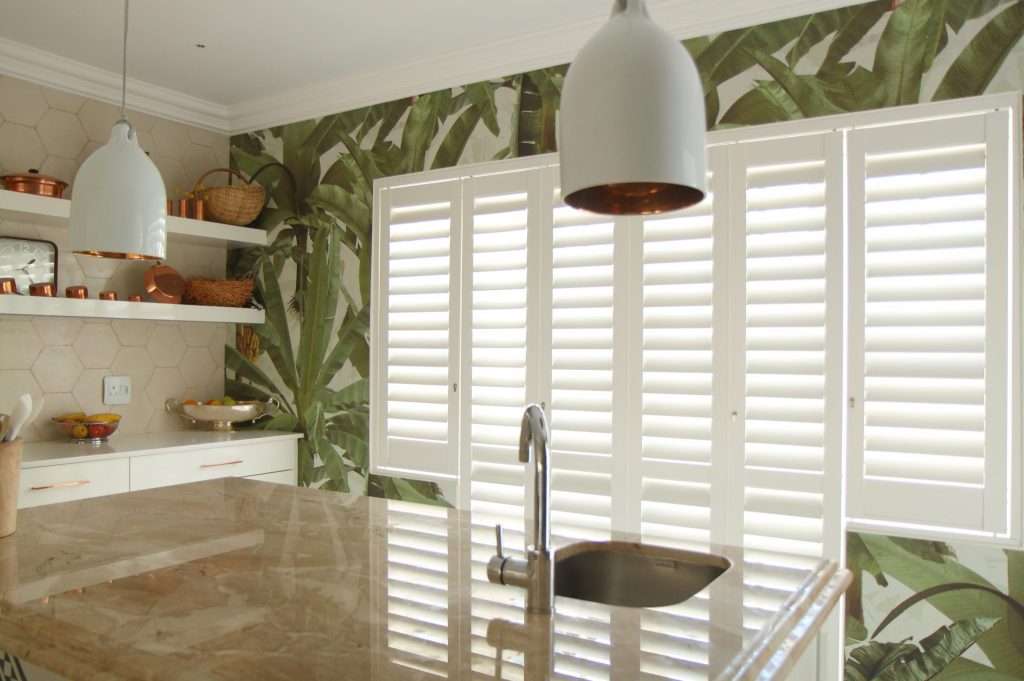
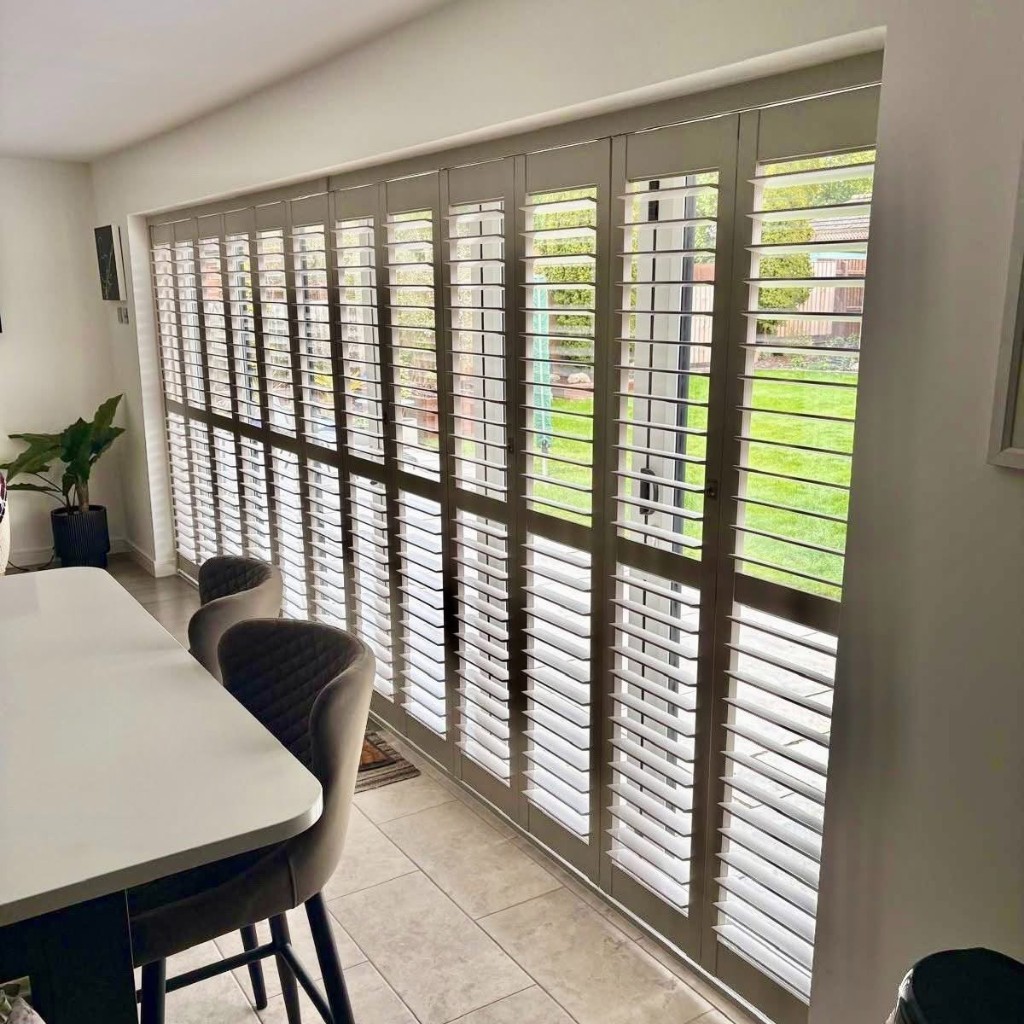
The image above is the classic aluminium use case: a ground-floor opening onto a back garden. On a four-panel configuration, the two outer panels hinge from the frame and the two inner panels carry the key locks at the centre. The satin-white finish shows the architectural quality of the aluminium, the slats give privacy and light control in the standard plantation way, and the inner panels lock — so a door that’s both the room’s main feature and the home’s most vulnerable opening doesn’t have to be either a security risk or covered in roller blinds at night.
What Aluminium Plantation Shutters Cost in 2026
UK ranges fully fitted, based on what we currently quote across Leicestershire:
- Standard casement window, plain white — £600–£1,000 per window fitted.
- Wider window or French door, plain white — £900–£1,400 per opening.
- Patio door (single-glazed sliding or modern multi-pane) — £1,200–£2,200 depending on width and configuration.
- Conservatory full glaze-out (multiple openings) — £3,500–£8,000+ depending on the conservatory size.
- Custom RAL or non-standard finish — usually a 10–15% premium on the painted item.
- Key-lock specification — usually included as standard on the Portchester range we fit; confirm in your quote.
For comparison, a like-for-like faux wood shutter on the same opening is typically about half the price. For comparison to MDF, see our MDF shutters honest verdict. For the cost ranges across every shutter material side by side, see the plantation shutters cost guide.
Where Aluminium Shutters Genuinely Win
If you take nothing else from this guide, take this list. These are the openings where we routinely quote aluminium and where the customer is glad they spent the money five years later:
- Ground-floor patio and French doors — security plus the plantation look the room deserves.
- Conservatory side walls and roof glazing — the only material that survives the temperature swings.
- South-facing bays with full afternoon sun — no bowing in summer, no fading in year ten.
- Persistent-condensation bathrooms — faux wood works in most bathrooms; aluminium is the answer for the worst ones.
- Side-return and accessible upstairs bedroom windows in homes where security has been a genuine concern.
- Long-term ownership of a forever home — over twenty years, aluminium is often the cheaper option in real money.
What to Ask the Surveyor
If you’re considering aluminium for some or all of a project, these are the questions worth asking:
- Which openings are you proposing aluminium for and why? A surveyor who has thought about your house will give a room-by-room reason, not “yes everywhere”.
- What’s the lock specification? Key-lock systems vary; the spec matters for both insurance recognition and how the shutter feels in daily use.
- What’s the comparison quote in faux wood? Get both. The 2× factor is easier to weigh in real numbers than as a percentage.
- What’s the lead time? Aluminium typically takes longer than faux wood from order to fitting (extrusion plus powder-coat); confirm so you can plan.
- What’s the warranty? Aluminium products usually carry the longest warranties in the shutter market. That gap is the manufacturer being honest about expected lifespan.
If you’d like the broader context on shutter material choices, our wood vs faux wood comparison covers the entry point to the category, and the MDF honest verdict covers the budget end.
Where We Fit Aluminium Shutters
We fit aluminium plantation shutters across Leicester, Loughborough, Melton Mowbray, Market Harborough and the wider Leicestershire area. The use cases vary by area — a lot of conservatory glaze-outs in the Charnwood villages, a steady stream of patio-door security work in Stoneygate and Clarendon Park, and an increasing number of contemporary new-build kitchen-diners where the anthracite finish is the deliberate design choice.
Book a Free Survey
The best way to decide whether aluminium is right for your project is to see a sample next to a faux wood sample in your own light. Mark visits, measures every opening you’re considering, brings physical samples of both materials in the colours you’re choosing between, and quotes both options properly so you can see the real-money difference. No pressure to choose aluminium where it isn’t needed, no pressure to choose faux wood where it isn’t right.
Book your free home survey → or call 07729 572277.
Frequently AskedQuestions.
What are aluminium plantation shutters made of?
Are aluminium shutters the same as roller shutters?
Are aluminium shutters more secure than wooden ones?
Do aluminium shutters look like normal plantation shutters?
Can you use aluminium shutters in a conservatory?
How much do aluminium plantation shutters cost in the UK?
Are aluminium shutters worth it?
Need advice for your own bedroom windows?Arrange a home visit →