Last reviewed: September 2026.
Bifold doors and wide sliding patio doors are brilliant for light and garden access — and awkward to dress. Curtains bunch, vertical blinds rattle, and a standard hinged shutter would swing straight into the kitchen table. Tracked shutters solve that: plantation shutter panels that run on an overhead track, then fold or slide clear so you can still use the doors.
This guide covers what we recommend on surveys across Leicester, Loughborough and Leicestershire: bifold vs bypass tracks, realistic 2026 costs, materials, and when a door-mounted blind is the smarter choice.
The Short Answer
- Tracked shutters are made for wide door openings — bifolds, sliding patio doors and large glazed runs.
- Bifold tracks fold panels into a stack at one or both sides — the widest clear opening.
- Bypass tracks slide panels behind each other — ideal for sliding patio doors and tight rooms.
- Stack space is the big planning point — folded panels need somewhere to live when open.
- Faux wood suits most kitchen-diners; aluminium for harsh sun, humidity or security on the rear elevation.
- Expect roughly £900–£3,500+ fitted depending on width, panel count and material.
- Blinds can be the better call on very wide or constantly used doors — we will say so on survey.
Why Doors Need a Tracked System
A hinged shutter on a window opens a few degrees into the room and stays out of the way. A door run is different: the panels are tall, the span is wide, and you need a clear path to the garden several times a day.
Common problems we see on Leicestershire extensions:
- Swing clearance — hinged panels on a 3-metre opening would hit dining chairs, islands and radiators
- Handle projection — door handles and locking levers need panels that sit proud of them
- Stack width — six to eight folded panels take up real wall space when open
- Track fixing — the head of the opening must take screws into something solid, not just plasterboard
- Floor level — tiles, thresholds and underfloor heating affect whether a bottom guide is used
That is why tracked shutters are a survey-led product. Even a small measuring error multiplies across eight panels — see why we never rely on self-measured sizes.
Bifold Track Shutters
Panels are hinged together in pairs and hang from carriers on an overhead track. To open, you fold them back concertina-style so they stack neatly to one side (or split to both sides on wide runs). Once stacked, the doors behind open fully.
Best for: bifold doors, kitchen extensions, garden rooms and any opening where you want the full width clear.
Watch for: the stack. A 3.5-metre run might need 50–70cm of wall beside the opening for the folded panels — we plan that around furniture and radiators before quoting.

Where panel height and weight allow, our Free-Floating option hangs the panels from the top track only, so there is no floor channel to trip over or catch dirt. Taller or heavier runs may still need a discreet bottom guide — that is a survey decision, not a catalogue default.
Bypass Track Shutters
Bypass panels do not fold. They sit on two or more parallel tracks and slide past each other, so one panel parks behind the next. Close them all and you get a continuous shutter wall; open them and the panels stack in depth rather than width.
Best for: sliding patio doors, rooms with no spare wall for a folded stack, and openings where you only ever use one door leaf.
Watch for: you never get the whole width clear at once — some glass is always behind parked panels. On a standard sliding patio door that is rarely a problem, because only one pane opens anyway. See our bypass track shutter in Mountsorrel for a real example.

Bifold vs Bypass: Which Suits Your Doors?
| Your doors | Usually best | Why |
|---|---|---|
| Bifold doors (3+ leaves) | Bifold track | Full opening when doors fold back |
| Sliding patio door (2 panes) | Bypass track | Only one pane opens; no stack needed |
| Wide run, tight side walls | Bypass track | Panels park in depth, not width |
| French doors | Usually hinged, not tracked | See our French door shutters guide |
| Very wide, used all day | Consider blinds | Door-mounted systems move with each leaf |
Materials for Tracked Door Shutters
| Material | Verdict | Best used |
|---|---|---|
| Faux wood / PVC composite | Practical default | Kitchen-diners, steamy cooking areas, busy family rooms |
| Hardwood | Premium, lighter per panel | Dry living and dining rooms wanting a natural finish |
| Aluminium plantation | Toughest option | South-facing glass, garden rooms, rear-elevation security |
| MDF | Not recommended | Tall door panels and kitchen humidity punish it |
Tall door panels are heavy, so weight matters on a track. Hardwood is lighter per panel; faux wood copes best with kitchen steam — see our kitchen shutters guide. For heat-heavy garden rooms, read the conservatory shutters guide and Portchester aluminium page.
A Real Tracked Install
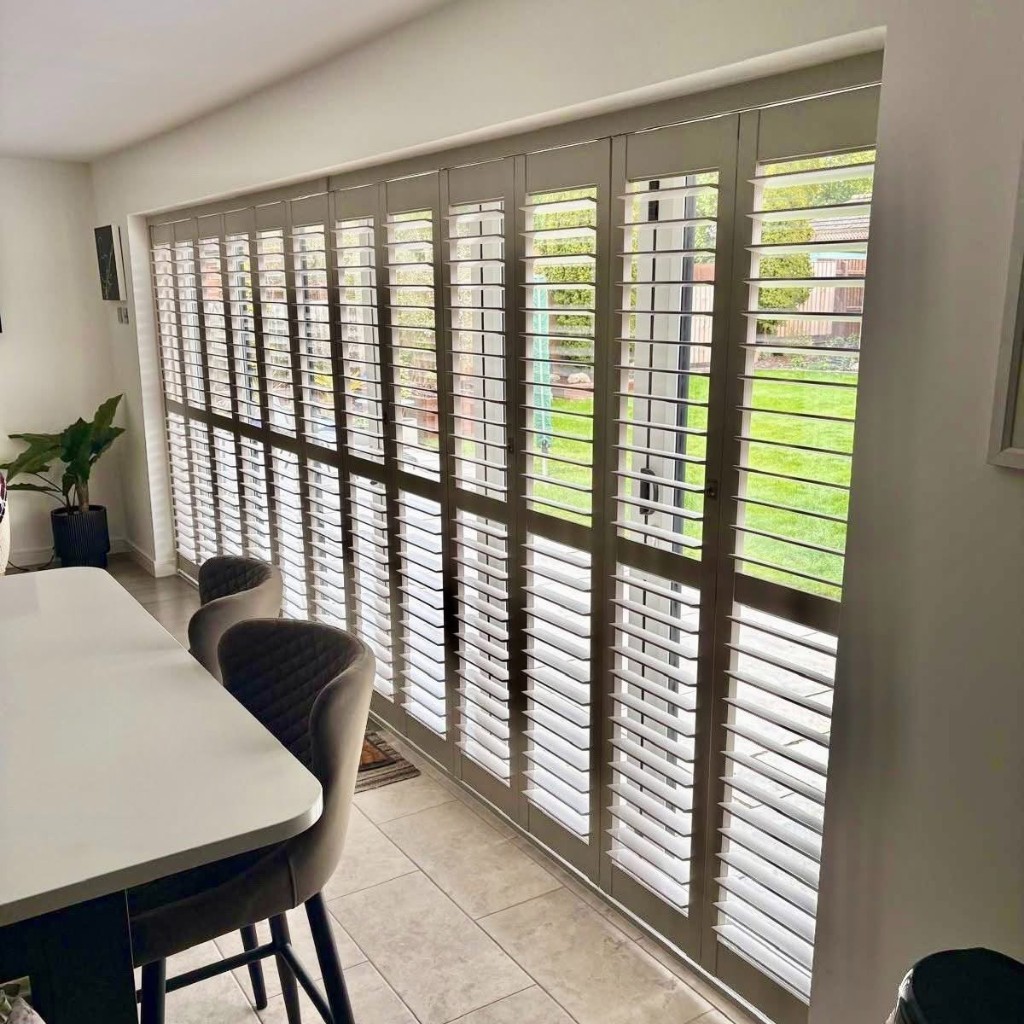
The photo at the top of this guide is one of our recent tracked shutter installs on a Leicestershire kitchen extension: a long run of panels with mid-rails lined up across the opening, louvres tilted for daylight and garden view.
More door projects: bi-fold door shutters in Leicestershire, full-height shutters on tall glass doors and Recent Work.
What We Check on a Tracked Shutter Survey
- How you use the doors — daily garden access, or mostly closed with one leaf in use
- Stack position — which side the panels park, and what furniture or radiators sit there
- Track fixing — lintel, ceiling or reveal, and whether it will take the panel weight
- Handle and lock projection — so panels clear every lever
- Floor finish — tiles, thresholds and underfloor heating for any bottom guide
- Louvre size and mid-rail height — matched across the run so it reads as one wall
For the full visit-to-fit journey, see the Shutter Envy process.
2026 Cost Guide for Tracked Shutters
Prices vary by width, panel count, height and material. As a planning aid for Leicestershire homes:
- Standard sliding patio door, bypass, mid-range faux wood: often about £900–£1,800 fitted
- Bifold run 3–4m, 6–8 panels, faux wood: often about £1,600–£3,500 fitted
- Hardwood or aluminium tracked runs: higher — quoted after survey
- Very wide or split-stack runs: higher panel count, extra track and carriers
Wider price context sits in our plantation shutters cost guide and shutters in Leicester: prices, timelines and quote checklist.
When Blinds Are the Better Choice
Tracked shutters are not automatic for every door. Consider blinds when:
- The doors are opened constantly and you do not want to fold panels first
- Side walls leave no room for a stack and bypass would cover too much glass
- Budget is tight across a very wide run
- You want blackout or insect mesh that moves with each door leaf — see BlindScreen® and our best blackout blind for bifold doors
- You want motorised daylight scenes — see motorised blinds for bifold doors
Compare the wider trade-offs in shutters vs blinds. We bring both on a home visit and will recommend whichever suits the way you use the doors.
Next Step
If you have bifold or sliding patio doors that need privacy, glare control or a more finished look, a home visit is the quickest way to a realistic fitted plan — bifold track, bypass, or blinds where they make more sense. Shutter Envy surveys and installs across Leicester, Loughborough and Leicestershire.
Book a free survey and quote — we will measure the opening, plan the stack and leave you with a clear fitted price.
Frequently AskedQuestions.
What are tracked shutters?
Can you put shutters on bifold doors?
What is the difference between bifold and bypass track shutters?
How much do tracked shutters cost in the UK?
Do tracked shutters stop the doors opening?
Are tracked shutters better than blinds on bifold doors?
Do you fit tracked shutters in Leicester and Loughborough?
Need advice for your own bedroom windows?Arrange a home visit →